
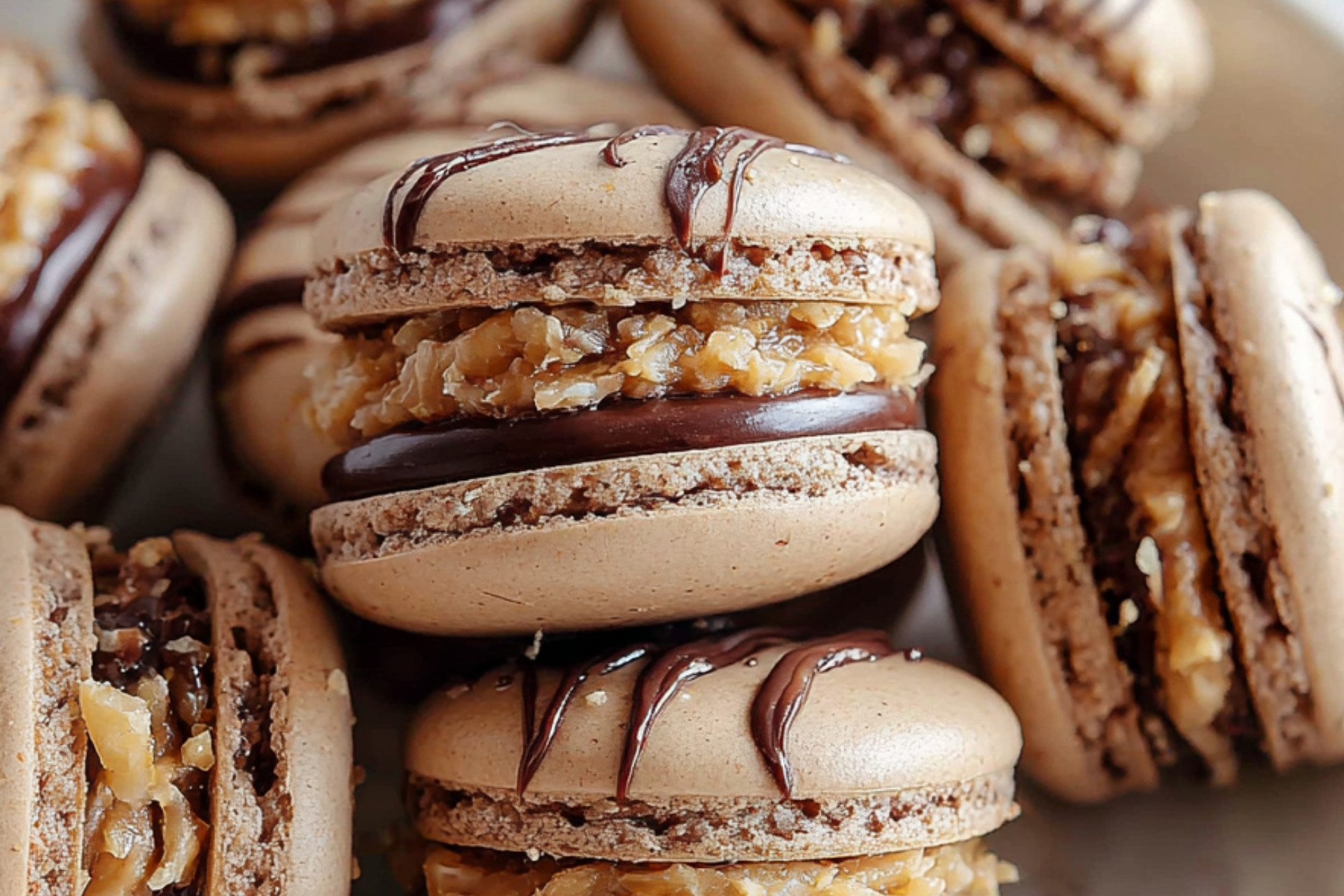
The Day I Fell for German Chocolate Cake Macarons
I remember the first time I bit into one. It was at a tiny bakery downtown. The coconut and pecan filling mixed with chocolate ganache. I closed my eyes to focus on the flavors. Ever wondered how you could turn a classic German chocolate cake into a tiny, perfect French cookie?
My First Go at These Little Wonders
My first batch came out looking like cracked eggs. The feet were lopsided, and the filling squished out the sides. I had overmixed the batter badly. My kitchen looked like a chocolate bomb went off. That mess taught me that patience in the kitchen always pays off.
What Makes This Combo Shine
First, the chewy coconut and crunchy pecans give the filling texture. Second, the rich chocolate shell balances all that sweetness perfectly. The ganache adds a smooth, creamy layer that holds everything together. Which flavor combo surprises you most in a macaron filling?
A Brief Trip to the Dessert’s Roots
German chocolate cake is actually named after an American baker named Samuel German. He created a sweet baking chocolate in the 1850s. The cake became a Southern US favorite in the 1950s. Now we marry that idea with French macaron technique. Did you know that the original cake uses buttermilk for tanginess?
| Ingredient | Amount | Note |
|---|---|---|
| Egg whites | 112 grams | room temperature |
| Super fine almond flour | 140 grams | double-sifted |
| Confectioners’ sugar | 140 grams | |
| Natural unsweetened cocoa powder | 20 grams | |
| Cream of tartar | 1/2 teaspoon | |
| Granulated sugar | 126 grams | |
| Shredded sweetened coconut flakes | 1/4 cup | for garnish (optional) |
| Semi-sweet chocolate morsels | 1/2 cup | |
| Heavy cream | 6 tablespoons | |
| Unsalted butter | 2 tablespoons | softened, cut into 14g pieces |
| Vanilla extract | 1 teaspoon | |
| Fine sea salt | 1/8 teaspoon | |
| Evaporated milk | 1/4 cup | |
| Light brown sugar | 1/4 cup | firmly packed |
| Unsalted butter | 1/4 cup | for filling |
| Large egg yolk | 1 | |
| Shredded sweetened coconut flakes | 1/4 cup | |
| Toasted pecans | 1/4 cup | roughly chopped |
| Vanilla extract | 1 teaspoon |
The Secret to Perfect Macaron Shells
Step 1 Separate your egg whites and let them come to room temperature. This helps them whip up tall and stable. Cold eggs will not give you stiff peaks. (Hard-learned tip: Wipe your bowl with vinegar to remove any grease.)
Step 2 Sift your almond flour, sugar, and cocoa powder twice. This removes lumps and makes your shells smooth. A kitchen scale gives you the most accurate measurements. Do not skip the sifting step.
Step 3 Whip the egg whites with cream of tartar until foamy. Add the granulated sugar slowly, one third at a time. Beat until the meringue forms stiff, glossy peaks. The meringue should stand straight up when you lift the whisk.
Step 4 Fold the dry ingredients into the meringue gently. This is called the macaronage process. The batter should flow like lava and ribbons disappear in 10 seconds. Overmixing will ruin your macarons.
Step 5 Pipe 1.5-inch circles onto a parchment-lined baking sheet. Bang the pan hard to release air bubbles. Let the shells rest for 60 minutes until a skin forms. Bake at 300°F for 24 to 27 minutes. Cook Time: 2–3 hours Total Time: 4 hours 30 minutes Yield: 24 macarons Category: Dessert, Cookies What is the most important step for getting tall feet on your macarons? Share below!
Three Fun Twists on This Recipe
1. Spicy Chocolate Version Add a pinch of cayenne pepper to the cocoa powder. The heat pairs nicely with the sweet coconut filling. It gives a grown-up kick to each bite.
2. Coconut Lime Spin Swap the vanilla in the filling for lime zest. The bright citrus cuts through the rich chocolate. It makes the macarons taste tropical and fresh.
3. Nutty Caramel Switch Replace the pecans with salted cashews. Drizzle a little caramel sauce on top of the filling. This adds a salty-sweet crunch you will love. Which twist sounds best to you? Vote for your favorite in the comments!
How to Serve Your Macarons
Serve these macarons on a pretty platter with fresh berries. A side of vanilla ice cream makes a nice contrast. You can also enjoy them with a light fruit salad. For a drink, try a cold glass of milk. It balances the rich chocolate and coconut. Adults might like a small cup of dark coffee. Which would you choose tonight?
How to Keep Your German Chocolate Cake Macarons Fresh
Store these macarons in an airtight container in the fridge. They will stay good for up to five days. For longer storage, place them in the freezer for up to three months. Let them thaw in the fridge overnight before serving. I once froze a batch for a last-minute party, and they tasted just made. Batch-cooking these is a smart move for busy weeks. Make a double batch on Sunday, and you have treats ready. Pull them out when guests pop by. Why this matters: you save time without losing taste. Have you ever tried freezing macarons for a surprise dessert?Three Common Macaron Problems and How to Fix Them
First, your shells crack on top. This often happens when the oven is too hot. Lower the temperature by 25 degrees next time. Use an oven thermometer to check. Why this matters: cracked shells waste your hard work. Second, the feet are missing or spread out. The batter is likely too wet. Fold the dry ingredients just until the batter flows like lava. Stop a few turns early to be safe. Do you check your batter’s consistency before piping? Third, the shells are hollow inside. This means they are underbaked. Give them two extra minutes in the oven. Let them cool completely before removing from the tray. A hollow shell can ruin the whole bite.Your Quick Questions Answered
Q: Can I make these gluten-free?
A: Yes, use almond flour for the shells. The regular recipe is already gluten-free.
Q: Can I make the filling ahead of time?
A: Yes, make the coconut-pecan filling up to three days early. Keep it covered in the fridge.
Q: What can I swap for coconut?
A: Try finely chopped walnuts or skip the coconut for a plain chocolate filling. It still tastes great.
Q: How do I double this recipe?
A: Just double all ingredients. Beat the egg whites in two batches to keep the meringue stable.
Q: Can I use a different chocolate?
A: Yes, dark or milk chocolate work well. Use a good brand for the best flavor.
Final Thoughts from Amelia
These macarons are a lovely twist on a classic cake. I hope you enjoy making them for someone special. Please share your photos and tag me on Pinterest atAmelia Hartwell. Your success makes my day. Happy cooking! —Amelia Hartwell.


German Chocolate Cake Macarons Recipe Guide
Description
Experience the delightful contrast of textures and flavors with this German Chocolate Cake Macarons Recipe Guide, featuring chocolate macaron shells, rich chocolate ganache, and German chocolate filling.
Ingredients
Instructions
- For Chocolate Macaron Shells: Separate egg whites from yolks, and allow egg whites to come to room temperature.
- Measure dry ingredients using a kitchen scale. Double-sift the almond flour, confectioners’ sugar, and cocoa powder together in a large mixing bowl.
- Wipe down the mixing bowl and whisk attachment with a little white vinegar on a paper towel to remove any leftover oils.
- Print off the macaron template. Place them on a light colored sheet pan underneath a piece of parchment paper.
- Prepare your piping bag with a ½ inch (1.3 cm) round tip. Push part of the side of the piping bag into the piping tip to ensure nothing leaks out. Set the bag inside a tall glass, and pull the remaining top of the piping bag out over the outside of the glass to make pouring the batter easy and clean.
- Add room temperature egg whites and cream of tartar to a stand mixer bowl fitted with a whisk attachment. Whip on medium-low speed until the eggs are very foamy, about 3 minutes. Add a third of the granulated sugar at a time, allowing the mixer to beat in each batch of sugar for about 45 seconds before adding in another batch.
- Once all the granulated sugar is incorporated, turn the mixer speed to medium-high, and allow the egg whites to continue to whip until stiff peaks form, about 10–11 minutes. Once at stiff peaks, you’ll notice the meringue starts to ball up inside the whisk and is glossy. To test the meringue stiffness, pull the whisk out. A stiff peak should stand straight up (no curl at the tip). You’ll also know it’s ready because you can fully flip the bowl over and nothing moves or falls out. Make sure not to overbeat the meringue at this stage (this is when the egg whites look dull or curdled).
- Pour the sifted almond flour, confectioners’ sugar, and cocoa powder into the meringue mixture, and gently fold them together using a silicone spatula. Continue until all the meringue is fully incorporated and no dry bits of almond flour remain on the bottom of the bowl.
- Begin working the batter until everything is fully incorporated (this is called the macaronage process). Slowly, spread the mixture along the side of the bowl, then wipe it back down. Be sure to do this gently. Repeat until the mixture has reached a smooth, shiny, flowing consistency. You can test this by lifting your spatula and seeing if the batter drops almost like lava. Once the batter drops back into the bowl, it should take about 10–15 seconds for the ribbon that formed to ‘disappear’ back into the rest of the batter. Don’t over macaronage the batter or the macarons will not properly bake in the oven.
- Pour the batter into the prepared piping bag. Hold the bag vertically, and pipe 1.5 inch (3.8 cm) circles. Once you have reached the desired size, release the pressure on the bag, and twist your wrist without lifting up. Continue until no batter remains.
- Bang the sheet pan down on the counter a few times to release any air bubbles. Pop the air bubbles with a toothpick. Optionally, top half of the macaron shells with coconut flakes while the batter is still wet. Allow the batter to sit on the counter and dry for 60+ minutes until a thin ‘skin’ develops, and you can touch the tops without ruining the macaron. This resting time will vary depending on the humidity (they may take up to 90+ minutes to dry if you live in a humid or rainy environment). While the macarons are drying, place the oven thermometer in the center rack of the oven. Heat oven to 300°F (150°C).
- Bake one sheet at a time on the center rack of the oven for 24–27 minutes. You can test that the macarons are done by gently touching the edge and the feet of the macarons. If the shell wiggles, is sticky, or wet, the macarons need to bake longer. Remove macarons from the oven, and allow the pan to rest on a wire cooling rack until completely cooled.
- For Chocolate Ganache: Place chocolate morsels and butter in a medium-sized heat-safe bowl.
- Heat heavy cream in the microwave on 100 percent power (high) for 45–60 seconds until the heavy cream begins to steam (but doesn’t boil over). Immediately, pour the heavy cream over the chocolate. Make sure all of the chocolate is submerged under the cream. Allow the mixture to sit, without stirring, for 3 minutes.
- Add vanilla extract and fine sea salt to the chocolate. Stir until the mixture is smooth and fully blended. If there are still bits of chocolate or butter after stirring for 60–90 seconds, heat the mixture in the microwave on 50 percent power (medium) for an additional 15–30 seconds, then stir until the correct consistency forms.
- Transfer ganache to a shallow container, and press plastic wrap against the surface of the ganache (to prevent a skin from forming on top). Place the ganache in the fridge, and allow the mixture to cool until it’s firm enough to pipe, about 1–2 hours.
- For German Chocolate Filling: Cook evaporated milk, brown sugar, butter, and egg yolk in a small saucepan over medium high heat until bubbling. Whisk constantly until the mixture begins to thicken, about 1–2 minutes.
- Remove from the heat, and stir in coconut flakes, pecans, and vanilla extract. Place in the fridge, and allow the mixture to cool until it’s firm enough to pipe, about 1 hour.
- Match up macaron shells so that a coconut top is paired with a similar size/shaped plain shell. Pipe the chocolate ganache filling along the outer edge of one side of the macaron shell using a ½ inch (1.3 cm) round piping tip. Spoon the german chocolate cake filling on the inside of the chocolate ganache. Gently, place the matching shell on top of the filling.
- Mature the macarons with the filling in an airtight container in the refrigerator overnight. This will allow the macarons to slightly soften and develop a deeper flavor.
- Store the macarons in an airtight container in the refrigerator for up to 3–5 days. To serve, allow the macarons to come to room temperature.
Notes
- For best results, ensure all ingredients are measured precisely with a kitchen scale. The resting time before baking is crucial for proper feet formation.